Dunmore
Mariners' Museum, Uncurated Search Results
Type: Schooner Barge
Year: 1905
Builder: Dawson Shipbuilding Co.
Location: Solomons

These records are found in the online catalog of The Mariners’ Museum and Park in Newport News, Virginia. Uncurated search results are presented to give researchers and interested readers an idea of whether the museum’s archives contain information about this vessel and whether it may be worthwhile to visit the museum’s catalog search page for further investigation. Uncurated results may be inaccurate or incomplete.
Search mode: Exact Name. Search phrase(s): "Dunmore". Results returned: 25. Results displayed in this table: 25.
Use these buttons to send uncurated search results to your own app or text document for further research. First, check the box for any row, or click "Select All" then uncheck any rows. Then click "Show Selections". You can then copy your selections from the text box and past them into your app.
| Fetch? | Row ID | Media | Date | Vessel | Place | Related Places | Inscription/Marks | Subject | Notes | Archive Number |
|---|---|---|---|---|---|---|---|---|---|---|
| 1 | No image URL. | Dunmore. | LB97542 | |||||||
| 2 | 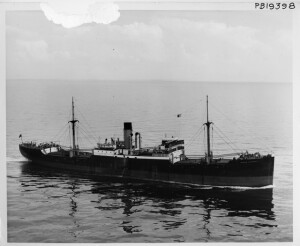 | WRITTEN ON VERSO: BUILT 1933 AT GLASGOW BY D&W HENDERSON & COMPANY LIMITED. 3,938 X 51.7 X 23.4. RENAMED RHAETIA | Starboard side aerial view underway. Upper left top side of print torn. Alternate Name: Rhaetia. | P0001.003/01-#PB19398 | ||||||
| 3 | 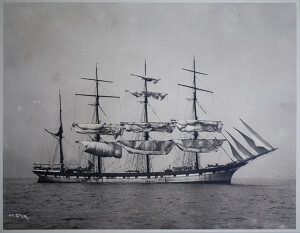 | Levick #31579. Earl of Dunmore. Stamped LR: Edwin Levick, New York. | Starboard view of 4 masted sailing ship | MS0576/01-#016 | ||||||
| 4 | 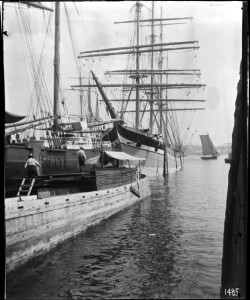 | 8/12/1895 | Earl of Dunmore (Bark : 1891). | Earle of Dunmore - (ship); 1485 | Sailing ships–New York (State)–New York.; Barks (Sailing ships)–New York (State)–New York.; Canal-boats–New York (State)–New York. | Shows a nearly head on view of the bow of a sailing ship. Just to the fore of her bow is the stern of another sailing ship with a canal-boat pulled alongside her. Stanton's notebooks contain the following information about this item: "on East R.", "August 12, 1895" | MS0094/01-#1485-A | |||
| 5 | No image URL. | Earl of Dunmore | P0001.011/01-0848 | |||||||
| 6 | No image URL. | Caption: Lake Dunmore, Vt. 1919. | MS0003/-006.3820 | |||||||
| 7 | No image URL. | Rockingham County (Va.)–History; Virginia–History–Revolution, 1775-1783 | Up Rockingham, down Dunmore : __the Revolution inspired Virginia to reward her English friends and rebuke her enemies | LB103773 | ||||||
| 8 | No image URL. | Virginia–History–Revolution, 1775-1783; Gwynn Island (Va.)–History–Revolution, 1775-1783 | Nemesis at Gwynn's Island : __master of less than he surveyed, Lord Dunmore established the last royal capital of Virginia on Gwynn's Island | LB104364 | ||||||
| 9 | 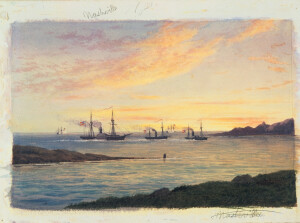 | NOTES: Note in file by John Sands, February 1985 states that the work is probably "after" a sketch by Dunmore. A section of the mat with the identification is in the object file. The acidic mat has been removed in order to preserve the object. A nearly identical watercolor in a private collection is marked "C.S.S. Nashville Blockade Running Dunmore 1862." The pieces are similar enough that its possible that John Sands is incorrect. The image actually shows the Nashville (by this point sold and renamed Thomas L. Wragg) being towed into Wilmington Inlet. The ship had run aground on the 24th of April. See the object file for additional information. The logbook of the CSS Nashville is held in the collections of the Virginia Historical Society. VESSEL INFORMATION-- VESSEL NAME: (1) NASHVILLE (1853-1861); (2) CSS NASHVILLE 1861-1862; (3) THOMAS W. WRAGG (1862); (4) RATTLESNAKE (1862-1863). VESSEL TYPE: wooden paddle side-wheel steamer SERVICE DATES: 1853-1862 SHIP BUILDER: Thomas Collyer BUILDER LOCATION: Greenpoint, New York ENGINE BUILDER: Novelty Iron Works VESSEL DIMENSIONS: 216' (length) x 34' *" (beam) x 22' (depth of hold); 1800 tons VESSEL HISTORY: Nashville, a 1221-ton side-wheel steamer, was originally a brig-rigged passenger steamer built by Thomas Collyer at Greenpoint, New York, in 1853. Engines built by Novelty Iron Works. The ship was originally a United States Mail Ship. In 1854 this vessel was chartered by the New York and Havre Steam Navigation Company to replace their lost steamer HUMBOLDT and in the following year by the Collins Line to replace the lost ARTIC. Between 1855 and 1861 she was engaged in running between New York City and Charleston, South Carolina. In 1855 she made the trip from Charleston to New York, bar to bar, in 45 hours, which was her best time. During the April 12-14, 1861 Battle of Fort Sumter, the USMS Nashville sailed into Charleston without flying the US national standard and was fired upon by the USRC Harriet Lane which marked the first shot of the naval war in the Civil War. The Nashville raised the American flag, and after the surrender of Sumter, the Nashville docked at Charleston where she was seized by the Confederacy. The ship was commissioned October 1, 1861 and converted to a lightly-armed cruiser. Nashville made one combat cruise under the Confederate Navy flag which started on October 21, 1861 when she ran the blockade. The vessel headed across the Atlantic to Southampton, England and was the first ship of war to fly the Confederate flag in English waters. She captured and burned the sailing merchantman Harvey Birch in the English Channel on November 19, 1861, and spent some time at Southampton, England. Returning to American waters early in February 26, 1862, she captured and burned the schooner Robert Gilfillan on 26 February. Two days later, she ran the blockade into Beaufort, North Carolina, remaining there until mid-March, when she went to Georgetown, South Carolina. Sold to private interests and renamed Thomas L. Wragg, she operated as a blockade runner, but was hindered in this employment by her deep draft. After arrival near Savannah, Georgia, she was sold again in November 1862, and commissioned as the privateer Rattlesnake. After she ran fast aground on the Ogeechee River, Georgia, the monitor USS Montauk destroyed her with shell fire from 11" and 15" turret guns on February 28, 1863. ADDITIONAL INFORMATION: See Recollections of a Rebel Reefer, by James Morris Morgan, Houghton Mifflin Company, 1917, pages 104-105. excerpt from pages 104-105: After a few pleasant days spent in Halifax the Cunard steamer Arabia, plying between Boston and Liverpool, came into port and we took passage on her for Liverpool. The Americans on board resented our presence and of course had nothing to do with us, but a number of young officers of the Scots Fusilier Guards, who were returning home for the fox hunting, were very friendly. They had been hurriedly sent to Canada when war seemed imminent on account of the Trent affair. It was the first time a regiment of the Guards had been out of England since Waterloo, and they were very glad to be returning to their beloved "Merry" England. Among these young officers was the Earl of Dunmore, who, a few months before, wishing to see something of the war between the States, had obtained a leave of absence, passed through the Federal lines and gone to Richmond and thence to Charleston. He had traveled incognito under his family name of Murray. At Charleston he had been entertained by Mr. Trenholm, and that gave us something to talk about. Dunmore was of a very venturesome disposition and instead of returning North on his pass, he decided to enjoy the sensation of running the blockade. The boat he took passage on successfully eluded the Federal fleet off Charleston, but she was captured by an outside cruiser the very next day. The prisoners were of course searched, and around the body of "Mr. Murray," under his shirt, was found wrapped a Confederate flag--the flag of the C.S.S. Nashville, which had been presented to him by Captain Pegram. Despite his protestations that he was a Britisher traveling for pleasure, he was confined, as "Mr. Murray," in Fort Lafayette. The British Minister, Lord Lyons, soon heard of his predicament and requested the authorities in Washington to order his release, representing him as being the Earl of Dunmore, a lieutenant in Her Majesty's Life Guards. But the commandant of Fort Lafayette denied that he had any such prisoner and it required quite a correspondence to persuade him that a man by the name of Murray could at the same time be Lord Dunmore. See Tangle Machinery and Charred Relics: The Historical and Archaeological Investigation of the CSS Nashville. by Franklin N. Chance, Paul C. Chance and David L. Topper. | CL12810 | |||||||
| 10 | No image URL. | Hart, Schaffner & Marx prize essays | Shipping bounties and subsidies–United States | Ship subsidies : __an economic study of the policy of subsidizing merchant marines __by Walter T. Dunmore | LB12229 | |||||
| 11 | No image URL. | Pacific Ocean–Discovery and exploration. | Explorers–France–Biography. | Includes index. | LB11866 | |||||
| 12 | No image URL. | Pacific Area–Discovery and exploration | Explorers–Biography–Pacific Area | Who's who in Pacific navigation __ __John Dunmore | LB8986 | |||||
| 13 | No image URL. | Oceania–Discovery and exploration. | Explorers–France. | French explorers in the Pacific __ __by John Dunmore | LB8987 | |||||
| 14 | No image URL. | Davey and the Awatea. | LB101150 | |||||||
| 15 | No image URL. | Astrolabe (Frigate); Boussole (Frigate) | Pacific Area–Discovery and exploration–French. | Works issued by the Hakluyt Society, 0072-9396 ; 2nd ser., no. 179 | Voyages around the world.; Discoveries in geography–French. | The journal of Jean-François de Galaup de la Pérouse, 1785-1788 __ __translated and edited by John Dunmore | LB35034 | |||
| 16 | No image URL. | Boudeuse (Frigate : 1766) | Pacific Ocean–Discovery and exploration.; Oceania–Description and travel. | Works issued by the Hakluyt Society, 0072-9396 ; 3rd ser., no. 9 | Voyages and travels–Early works to 1800.; Explorers–History–18th century. France | The Pacific journal of Louis-Antoine de Bougainville, 1767-1768 __ __translated and edited by John Dunmore | LB86794 | |||
| 17 | No image URL. | Kursk (Submarine : 1994); H.L. Hunley (Submarine : 1863). | Submarine disasters; Submarine disasters–History; Submarines (Ships); Marine accidents–History; Submarine rescue vehicles; Underwater archaeology. | Lost subs : __from the Hunley to the Kursk, the greatest submarines ever lost--and found __by Spencer Dunmore ; introduction by Dr. Robert D. Ballard | LB86077 | |||||
| 18 | No image URL. | Diagrams. | LB79337 | |||||||
| 19 | No image URL. | Lusitania (Turbo steamship : 1907). | Shipwrecks–History–20th century. | "A Warner/Madison Press book." | LB96722 | |||||
| 20 | No image URL. | Norfolk (Va.)–History–Revolution, 1775-1783 | Freedom of the press–Virginia | Very standard of liberty : __Lord Dunmore's seizure of the Virginia Gazette, or the Norfolk intelligencer | LB104344 | |||||
| 21 | No image URL. | St. Jean Baptiste (Ship) | New Zealand–Discovery and exploration | The fateful voyage of the St. Jean Baptiste : __a true account of M. de Surville's expedition to New Zealand & the unknown South Seas in the years 1769-70 | LB13113 | |||||
| 22 | No image URL. | Triumph (Ship); Tiritiri Lighthouse (N.Z.) | Shipwrecks–New Zealand–Tiritiri | Triumph : __the ship that hit the lighthouse __David Johnson | LB21626 | |||||
| 23 | 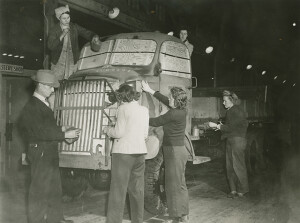 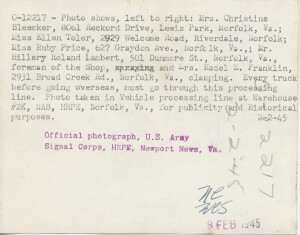 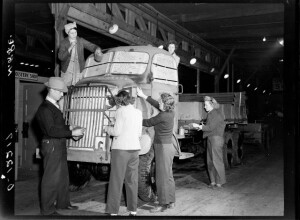 | 2/2/1945 | Photo shows, left to right: Mrs. Christine Bleecker, 8061 Reckord Drive, Lewis Park, Norfolk, Va.; Miss Ellen Toler, 2929 Welcome Road, Riverdale, Norfolk; Miss Ruby Price, 627 Graydon Ave., Norfolk, Va.,; Mr. Hillery Roland Lambert, 501 Dunmore St., Norfolk, Va., foreman of the Shop and Mrs. hazel E. Franklin, 2931 Broad Creek Rd., Norfolk, Va., clamping. Every truck before going overseas, must go through this processing line. Photo taken in Vehicle processing line at Warehouse #2k, NAB, HRPE, Norfolk, Va., for publicity and Historical purposes. | Military trucks–Virginia–Norfolk. | Shows five women working on a military truck to prepare it for shipping while a male supervisor looks on. | P0003/01-#O-12217 | ||||
| 24 | 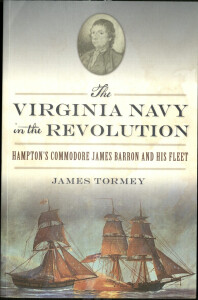 | Virginia. Navy–Biography. | United States–History–Naval operations. Revolution, 1775-1783; Virginia–History–Naval operations. Revolution, 1775-1783; Virginia–History, Naval–18th century.; Hampton (Va.)–Biography. | Ship captains–Virginia–Biography. | The Virginia Navy in the Revolution : __Hampton's Commodore James Barron and his fleet __James Tormey | LB105461 | ||||
| 25 | 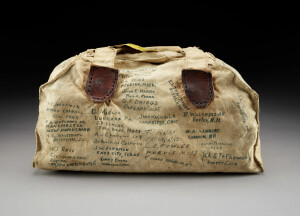 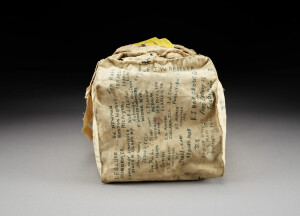 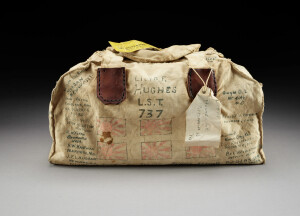 | SHORT DESCRIPTION: A WWII era ditty bag sewn and used by Petty Officer 2nd Class, Lloyd F. Hughes. He had fellow crew members sign the bag while deployed. NOTES: Mr. Hughes was born on November 1, 1899. Petty Officer 2nd Class Hughes enlisted in the navy on March 29, 1944 and reported to LST-737 on July 24, 1944. LST-737 was assigned to the Asiatic-Pacific theater during WWII and participated in various operations including, Ormoc Bay landings in December 1944, Lingayen Gulf landing in January 1945, and the assault and occupation of Okinawa Gunto from March to June 1945. It appears that Hughes was wounded in late June 1945 during the assault and occupation of Okinawa Gunto and was transferred to USS Gosper for medical treatment.The bag has the baggage tag to Pearl Harbor. The codename for this operation was Operation Iceberg. Descendants say Hughes was an electrician mate, but also held different responsibilities including chaplain. Hughes passed away on August 29, 1967. VESSEL INFORMATION: Vessel Name: USS LST-737 (LANDING SHIP TANK: 1944-1946) History: During World War II USS LST-737 was assigned to the Asiatic-Pacific theater and participated in the following operations: capture and occupation of southern Palau Islands- September and October 1944; Leyte landings- October and November 1944; Ormoc Bay landings- December 1944; Lingayen Gulf landing- January 1945; Zambales-Subic Bay- January 1945; and the assault and occupation of Okinawa Gunto- March through June 1945. Naval History and Heritage Command noted that “following the war, LST-737 performed occupation duty in the Far East until early November 1946. She was decommissioned and transferred to the United States Army on 2 November 1946. The ship was struck from the Navy list on 29 September 1947.” LST-737 earned five battle stars for its service during WWII. Vessel Type: Landing ship tank Official Number: LST-737 Date Built: 1944; Laid down: February 13, 1944; Launched: March 25, 1944; Commissioned May 6, 1944; Decommissioned November 2, 1946 Location Built: Pittsburg, Pennsylvania Dimensions: Full displacement: 1675T; 328’x50’ Builder: Dravo Corporation Owner: United States Navy Ship Line: United States Navy Disposition: Decommissioned and transferred to the United States Army on November 2, 1946. The ship was struck from the Navy list on September 29, 1947. Notes: For more information about the vessel history visit the Naval History and Heritage Command website. | CL31447 |
Created 2026 by Don Barker, CBMM volunteer, for the Chesapeake Shipbuilding Project. shipbuilding@sailingworkboats.es